


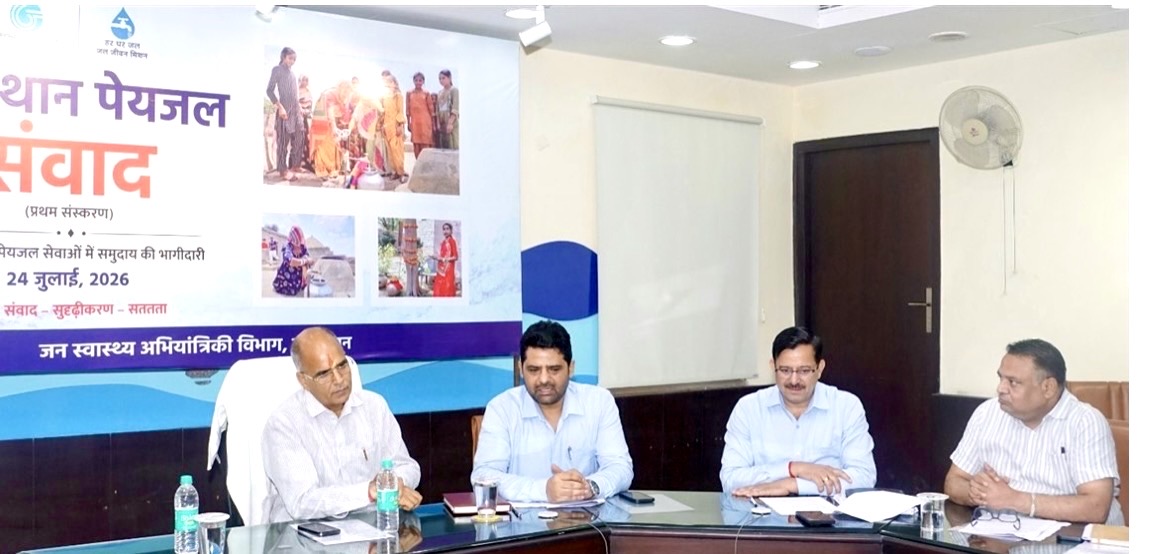
From the pending files of Secretariat, Jal Jeevan Mission has gradually reached the rural households with renewed focus and confidence in the mission. So much so that, the state government has decided to hold direct interaction every month with end users at a public platform – Rajasthan Peyjal Samvaad – after a successful dialogue with panchayats of four districts.
So far, 13,850 villages are fully covered with functional households while 6,172 villages have received Har Ghar Jal Certification.
PHED minister Kanhaiya Lal Choudhary said that with initiatives like Rajasthan Peyjal Samvaad, the department is directly connecting with those villages where tap water supply has reached every household.
“This will help us assessing the actual status of the schemes as well as ensure time-bound resolution of problems at the local level,” he said.
The happened in first Peyjal Samvaad?
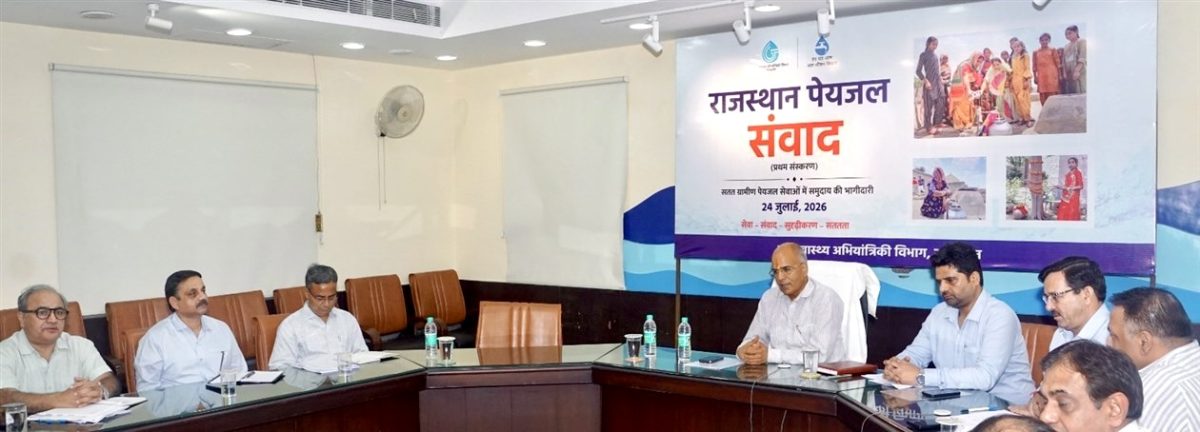
Through direct interactions with members of village Water & Sanitation Committees from Har Ghar Jal-certified Gram Panchayats, Jaliya , Block Mandalgarh, District Bhilwara, Kotdi , Block Arnod, District Pratapgarh ; Banor, Block Pirawa, District Jhalawar and Runija , Block Parbatsar, District Deedwana- Kuchaman, officials of Jal Jeevan Mission heard first-hand how household tap water has reduced the burden on women, how regular water quality testing has strengthened public confidence, and how community participation is making rural water supply systems more sustainable.
Why Samvaad is needed?
The Samvaad will ensure that policies are continuously refined by the experiences and insights of the communities they serve.
“During Samvaad, voices from villages would directly reach policymakers, bringing grassroots feedback into the heart of governance,” said Jal Jeevan Mission Director Rajan Vishal, who is also ex-officio Secretary PHED.
He said that the unique initiative of direct dialogue with public will help in transferring government ownership to community ownership ensuring reliable water services through building infrastructure.
“The dialogue also helped identify operational challenges, document best practices, with and showcase successful models such as Kotdi Gram Panchayat, demonstrating the power of community-led water governance,” Vishal said.
The dialogue also helped identify operational challenges, document best practices and showcase successful models such as Kotdi Gram Panchayat, demonstrating the power of community-led water governance.
“For a water-scarce state like Rajasthan—with over 10% of India's geographical area but only about 1% of its surface water resources-lasting water security cannot be achieved through infrastructure alone. It requires continuous dialogue, community ownership, accountability, and evidence-based policymaking,” Vishal said.